
Future of Industrial Safety is Managed Engineering
In the high-stakes world of industrial operations, the margin for error is vanishingly small. Complex electrical systems form the nervous system of modern infrastructure, powering everything from data centers and hospitals to manufacturing plants and utility grids. Yet, for too long, the standard approach to maintaining these critical systems has been reactive—waiting for a component to fail before rushing to fix it.
This "break-fix" mentality is not only inefficient; in an era of stringent regulations and soaring operational costs, it is a liability.
The future of operational excellence lies in a paradigm shift: the convergence of high-level engineering consulting with ongoing, technology-driven managed services. This hybrid model moves businesses from a posture of reaction to one of prediction and prevention.
A prime example of this evolution is Bowtie Engineering, a firm that has redefined the landscape by pairing expert consulting with powerful digital tools like their proprietary electrical maintenance app. By integrating real-time data visibility with deep engineering expertise, they demonstrate how managed solutions can transform safety and compliance from a burden into a strategic advantage.
The Convergence of Engineering and Managed Services
Traditionally, "engineering" and "maintenance" were treated as separate silos. Engineers designed the systems, and maintenance teams kept them running, often with little communication between the two until something went wrong.
Managed engineering services bridge this gap. They represent a holistic approach where the firm that helps you understand your risk also helps you manage it daily. This model offers a continuous loop of improvement:
The Continuous Improvement Loop
- Assessment: Engineering experts evaluate the system for hazards (such as Arc Flash risks).
- Implementation: Solutions are deployed to mitigate those risks.
- Management: Software and ongoing support ensure those solutions remain effective over time.
This continuity is vital. An electrical safety study is only a snapshot in time; without a managed service to track changes, updates, and maintenance schedules, that expensive study becomes obsolete the moment a new piece of equipment is installed.
Spotlight on Bowtie Engineering: A "Systems Approach" to Safety
Bowtie Engineering serves as an ideal case study for this integrated model. Their philosophy is rooted in the "Bowtie" risk analysis method—visualizing the complex relationship between threats, consequences, and the barriers put in place to prevent them.
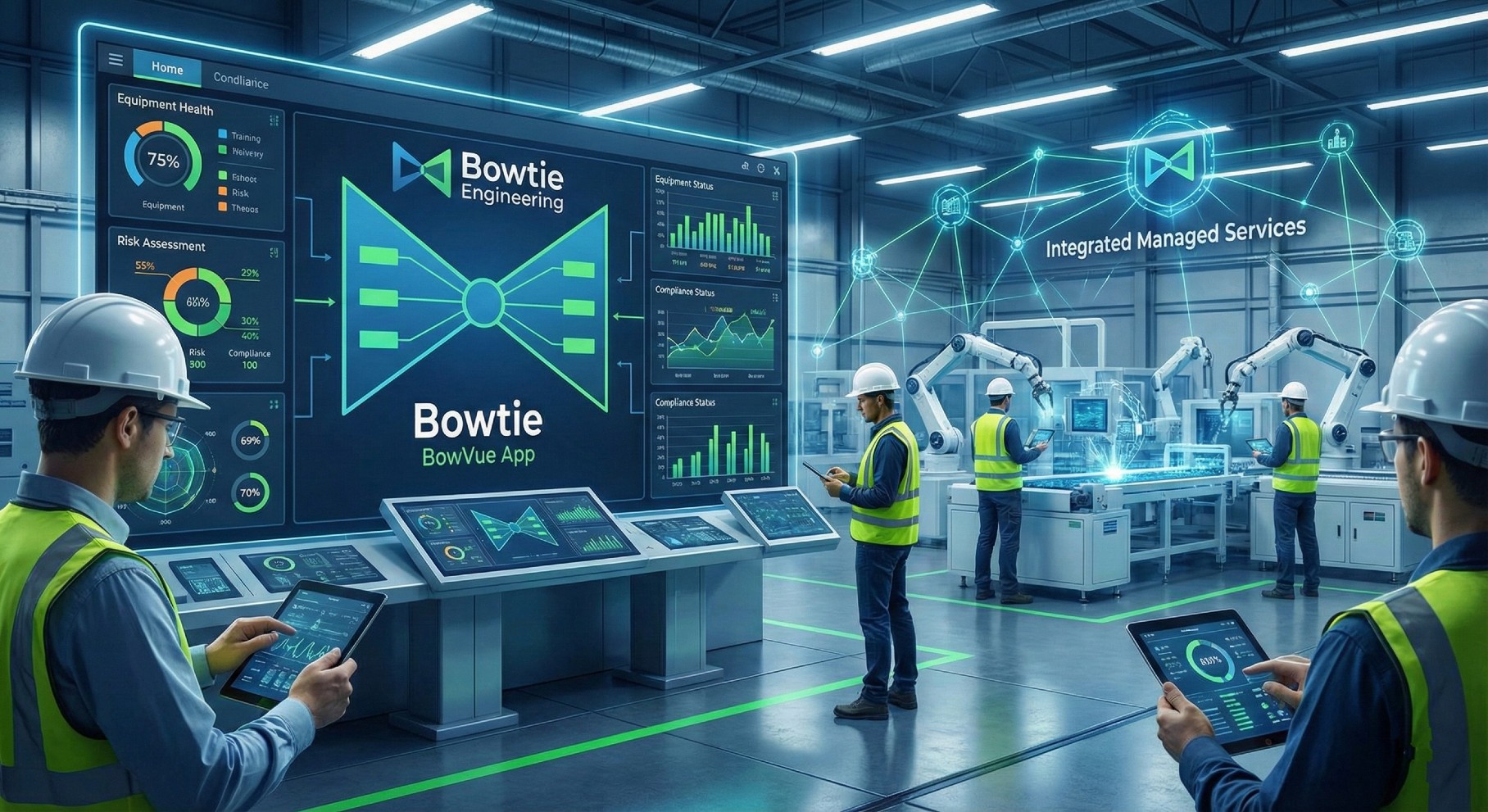
However, what sets them apart is not just their consulting, but their delivery mechanism. They recognized that complex data is useless if it sits in a binder on a shelf. To solve this, they developed BowVue, a dashboard-based managed service tool that puts critical safety data directly into the hands of the people who need it most.
Real-Time Risk Visibility
Through their managed service platform, facility managers can see the status of their entire electrical infrastructure in "one view." Instead of guessing which panels need maintenance or which assets are non-compliant, the data is centralized. This allows for decision-making based on engineering facts, not assumptions.
The "Qualified Worker" Connection
One of the most difficult aspects of OSHA and NFPA 70E compliance is ensuring that only qualified personnel work on specific energized equipment. A managed solution automates this check. By linking risk assessments directly to worker qualifications within the app, businesses can ensure that the person opening the panel has the right training and the right Personal Protective Equipment (PPE) for that specific task.
From Compliance to Culture
Compliance with standards like NFPA 70E is often seen as a box-checking exercise. Managed engineering services transform it into an operational culture. When safety data—such as incident energy levels (cal/cm²)—is readily accessible on a mobile device or desktop, safety becomes a seamless part of the daily workflow rather than an interruption.
The Strategic Benefits of Managed Engineering Solutions
For business leaders and facility managers, partnering with a firm that offers a managed service solution delivers tangible ROI beyond just "safety."
Operational Continuity and Efficiency
Unplanned downtime is the enemy of profitability. Managed services prioritize preventive and predictive maintenance. By using data to track the "condition of maintenance," teams can address "hot spots" identified by infrared thermography or aging components before they fail catastrophically. This keeps production lines moving and lights on.
Audit Readiness
In the event of an OSHA audit or an insurance inspection, the "paper trail" is everything. A scattered collection of spreadsheets and emails is a recipe for fines. A managed engineering platform provides an instant, audit-ready history of every maintenance task, safety training record, and risk assessment. It proves not just that you have a safety program, but that you are actively managing it.
Standardization Across Multi-Site Operations
For organizations with footprints across multiple states or countries, consistency is a major challenge. How do you ensure the safety protocol in a facility in Texas matches the one in Ohio? Managed engineering solutions provide a single "source of truth." A centralized platform ensures that engineering standards, labeling conventions, and safety procedures are standardized across the entire enterprise, reducing legal liability and streamlining training.
Key Takeaway: The transition from reactive to proactive isn't just about technology—it's about transforming safety from a compliance burden into a competitive advantage that drives operational excellence and protects your most valuable assets: your people and your infrastructure.
Conclusion: Engineering the Path Forward
The complexity of modern industrial systems demands a modern solution. The days of relying on static reports and reactive maintenance crews are fading. In their place, a new standard is emerging—one where engineering intellect is amplified by managed service technology.
Companies like Bowtie Engineering are leading this charge, proving that when you equip qualified professionals with the right data and the right tools, you don't just prevent accidents—you build a business that is more resilient, more efficient, and fundamentally safer.
For any organization looking to future-proof its operations, the message is clear: don't just maintain your systems; manage them with engineering precision.