
EHR Software for Solo Therapists: A Practical Buyer's Guide
If you run a solo therapy practice, your workday rarely ends when your last client walks out the door. There is the progress note you never quite finished between sessions, the intake packet a new client still hasn't returned, a couple of reschedule texts, and a superbill someone needs for their insurance. None of it is clinical work. All of it is yours.
This is the quiet tax of going solo. You traded a clinic's bureaucracy for autonomy, and in the bargain you also inherited the front desk, the billing department, and the IT team. The frustrating part? A lot of the software that is supposed to help ends up being part of the problem: built for sprawling group practices, priced for them too, and crammed with modules a one-person office will never open.
So here is the shift worth making before you compare a single feature list. The real question is not "which EHR can do the most?" It is "which system gets out of my way?"
For a solo clinician, the right electronic health record should fade into the background, quietly handling documentation, scheduling, and payments so the bulk of your attention stays where it belongs, with the person sitting across from you.
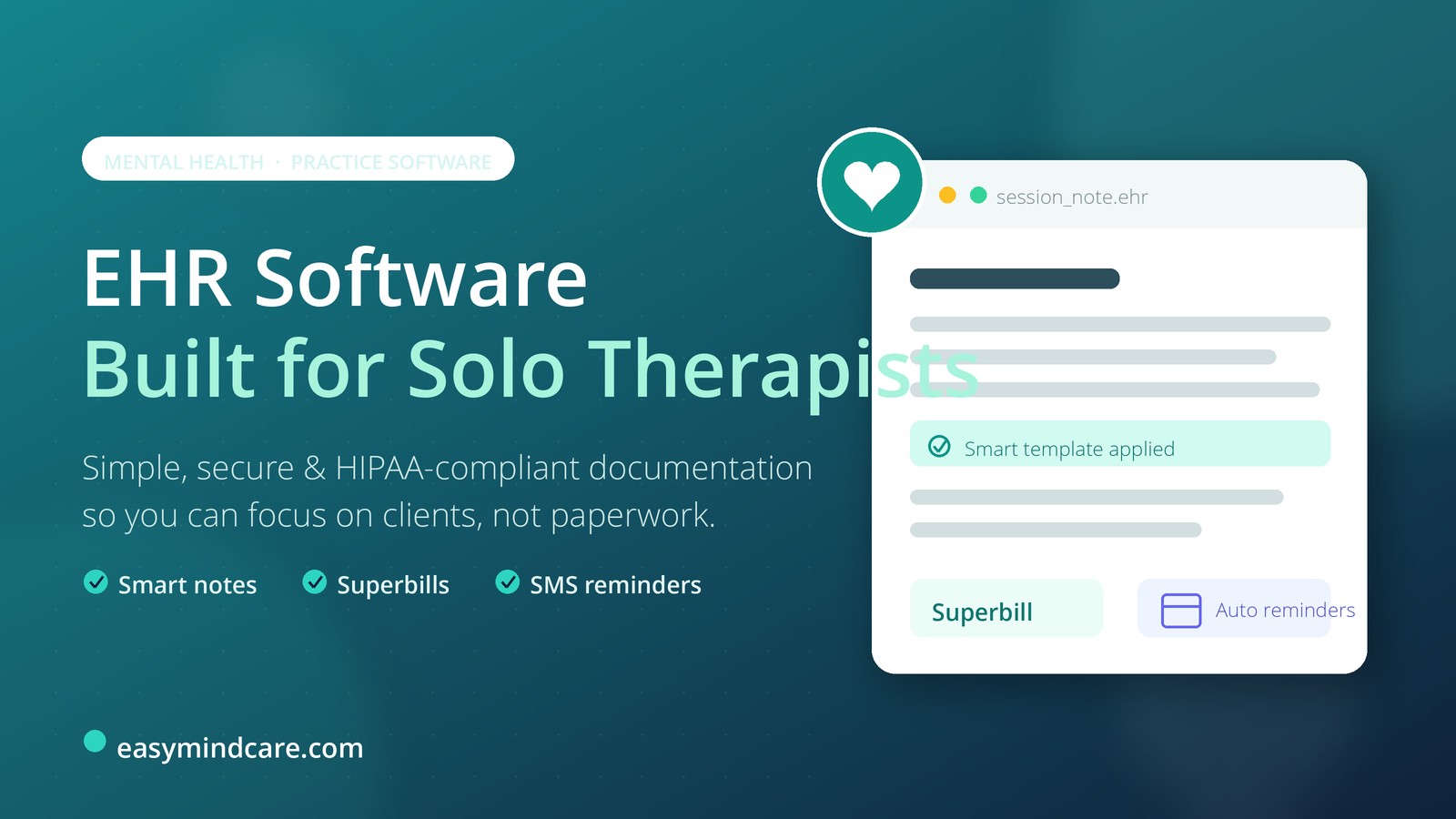
That is a narrow, specific need, and it is exactly the gap a purpose-built ehr for solo practitioners is designed to fill. A platform like EasyMindCare is not trying to coordinate a forty-clinician behavioral health center. It is trying to give one therapist a tidy, compliant, and genuinely simple place to do the paperwork. Once you notice that difference in design philosophy, you start seeing it everywhere.
Why Generic EHR Software Fails a One-Person Practice
Most of the big names in the EHR market grew up serving hospitals and multi-provider clinics. That heritage is baked into the product. You get role hierarchies you don't need, configuration screens that assume a dedicated office manager, and onboarding that can swallow a weekend. For a solo therapist, "powerful" often just translates to "another thing to learn."
It helps to look at the work itself. Every solo practice runs the same loop, week after week, and one person carries all of it:
The Admin Loop Every Solo Therapist Knows
- Before the session: send intake forms and consents, confirm the appointment, and hope the reminder actually lands.
- During and after: capture a progress note, update the treatment plan, and log anything that needs follow-up.
- Afterward: generate the invoice or superbill, take the payment, and reconcile who still owes what.
In a group practice, that loop gets split across people. A receptionist handles reminders, a biller handles claims, an admin handles records. Run solo, and you are all three roles, every single week. So the value of an EHR is not measured by how many features it lists. It is measured by how much of that loop it quietly takes off your plate.
A feature you have to think about is a feature working against you. The best documentation tool for a solo practice is the one you almost forget you are using: notes that carry forward, templates that match how you actually work, and reminders that fire without you lifting a finger.
Spotlight: What "Built for Solo" Actually Looks Like
EasyMindCare is a useful case study here, because its whole pitch is restraint. Setup is measured in minutes rather than days, and the interface stays deliberately plain so you are not hunting through menus in the middle of a session.
The thoughtful touches show up in the details clinicians actually feel. You can build your own forms for EMDR, play therapy, or a standard intake in a few minutes instead of fighting a rigid template. Notes carry over from previous sessions, so you are not retyping the same history every week. And the security that makes most therapists nervous (HIPAA, encryption, a signed BAA) is simply the default rather than a checklist you maintain yourself.
Notes That Don't Fight You
Documentation is where solo therapists lose the most time, so test this first. Look for smart templates, the ability to carry information forward between sessions, and quick notes you can finish in the five minutes before your next client. The goal is a chart that is genuinely useful later, written without eating your evening.
Security You Don't Have to Babysit
Handling protected health information is non-negotiable, and as a solo practitioner you are the compliance officer too. A purpose-built mental health EHR bakes in HIPAA compliance, bank-level encryption, and a Business Associate Agreement, so "are we secure?" stops being a question you lose sleep over.
The Money Side, Handled
Cash flow is survival in private practice. The right system generates compliant Superbills in one click for out-of-network clients, supports private-pay invoicing and auto-pay, and keeps a clean record of who has paid. Getting reimbursed should not require a spreadsheet and a lost Sunday afternoon.
What the Right EHR Actually Buys You
Strip away the feature comparisons and the return on investment for a solo therapist comes down to three things you can feel almost immediately.
Your Evenings Back
When notes are half-written for you, reminders go out automatically, and billing is a click instead of a chore, the after-hours admin pile shrinks fast. Save three hours a week and that is three hours returned to clients, to supervision, or simply to logging off at a reasonable time.
Fewer No-Shows, Steadier Income
Empty slots are pure lost revenue for a solo practice, and you can't backfill them with a colleague. Automated SMS reminders and frictionless rescheduling keep your calendar full and predictable, which is one of the quietest but most direct ways software pays for itself.
Compliance Without the Anxiety
An audit-ready trail of notes, consents, and records does more than satisfy regulators. It gives you proof that you are handling client data responsibly, which matters the day a question actually comes up. Peace of mind is hard to put on an invoice, but every solo clinician knows what it is worth.
Key takeaway: For a solo therapist, EHR value is not counted in features. It is counted in reclaimed hours and a quieter mind. If a tool gives you back even one evening a week, it has already earned its keep.
Conclusion: Choose the Tool That Gets Out of Your Way
The mental health EHR market is crowded with platforms competing on the length of their feature lists. For a one-person practice, most of that is noise. The system that serves you best is the one you barely notice, the one that handles notes, scheduling, and billing in the background while you focus on the work that drew you to this profession in the first place.
So when you weigh your options, judge them by a single honest question: at the end of a full week of clients, does this software leave me with more time and less worry, or less? Purpose-built tools like EasyMindCare are betting that simplicity, security, and a sane price are exactly what a solo practitioner needs.
Don't buy the biggest platform. Buy the one that gives you back your practice and your evenings.