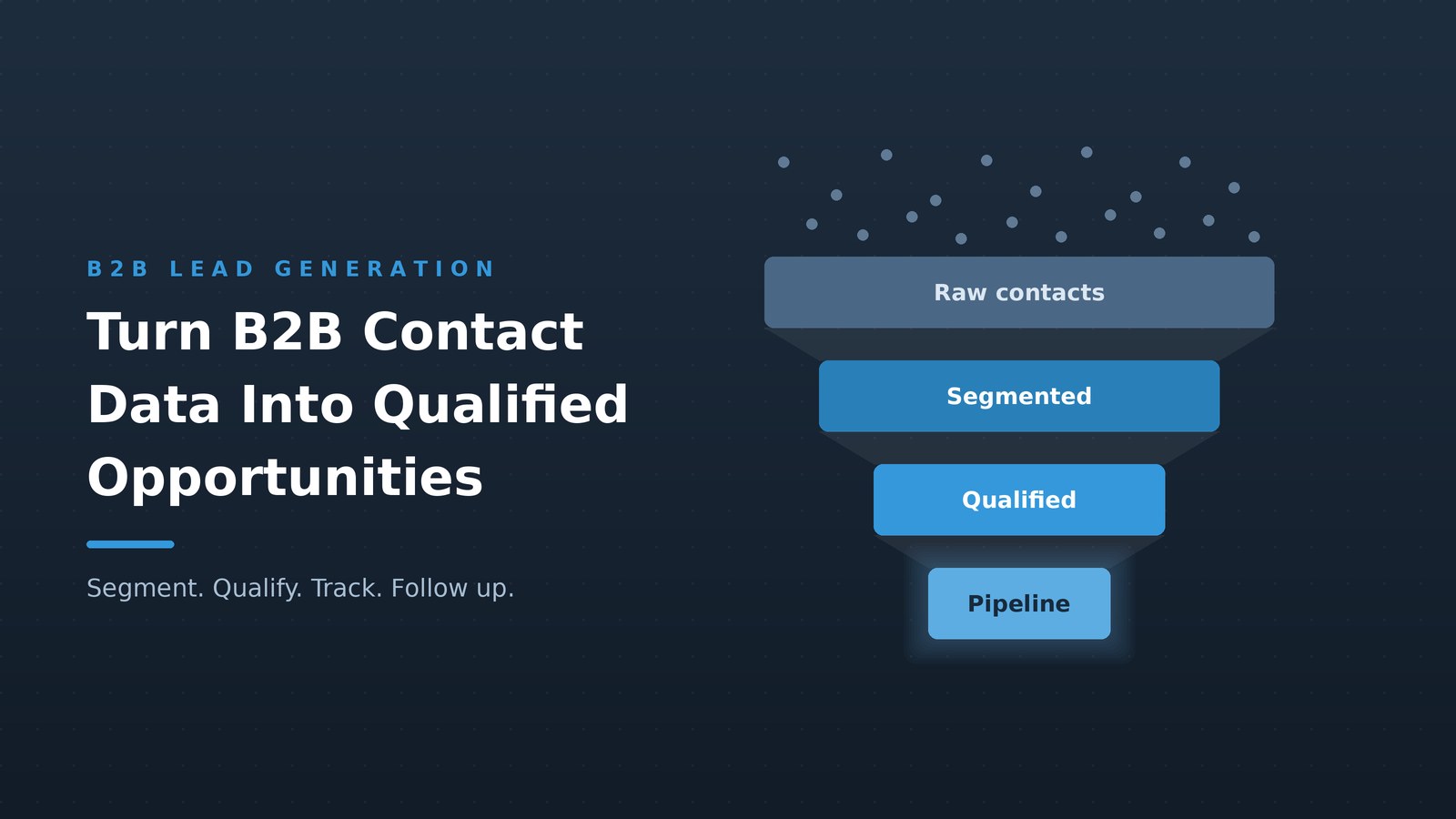
How to Turn B2B Contact Data Into Qualified Sales Opportunities
A contact database is an input, not a pipeline. It is easy to forget that once you have spent money on a good data source, whether that is a company database, LinkedIn export, or an enrichment tool feeding your CRM. The list arrives clean, sized, and filtered, and it feels like progress. It is not, on its own. A list of the right people is only the raw material. The commercial value comes from what happens to it next.
Most teams that struggle with lead generation are not struggling to find data. They are struggling to convert it. This article covers the process that sits between a contact list and a qualified sales opportunity: segmentation, enrichment, messaging, qualification, CRM capture, follow-up, and measurement. It also covers when it makes sense to build that process internally, and when it makes more sense to bring in outside help.
Start With the ICP, Not the List
The instinct with any new data source is to pull as many records as possible and start reaching out. That is backwards. Before you build or buy a list, you need a clear, specific ideal customer profile: industry, company size, buying triggers, relevant technology or process context, and the roles and seniority of the people who actually make or influence the decision.
A vague ICP produces a large, low-quality list. A specific one produces a smaller list that converts at a meaningfully higher rate. If your current definition of who to target is "companies that might need this," the data itself is not the problem yet. The targeting is.
This matters more with purchased or scraped data than with anything else, because the volume is tempting. A database with tens of thousands of matching records is not a sign you are ready to scale. It is a sign you need to narrow the filter before you spend a single message on outreach.
Segment Before You Enrich
Once you have a list that matches your ICP, the next step is grouping it into meaningful segments rather than treating it as one undifferentiated pool. Useful segmentation usually combines a few dimensions:
Four Dimensions Worth Segmenting On
- Firmographic fit: industry, company size, region, growth stage.
- Role and seniority: decision-maker, influencer, or end user, since each needs a different message.
- Buying signal strength: recent funding, hiring activity, technology adoption, leadership change, or other indicators that suggest active or emerging need.
- Existing relationship: cold contact, warm but unengaged, or previously nurtured.
Segmentation changes what enrichment is worth doing. There is no point spending enrichment budget deeply researching a segment you are unlikely to prioritise. Decide the segments first, then enrich the ones that matter with the context that will actually change how you approach them: recent news, technology stack, org structure, or specific pain signals relevant to your offer.
Tailor Messaging by Segment, Not by Template
A single outreach template sent to every record in a database is activity, not strategy. Different segments need different openers, different framing, and in some cases entirely different value propositions.
A decision-maker at a fast-growing mid-market company responds to a different message than an influencer at an enterprise account evaluating vendors on a twelve-month cycle. Treating them the same wastes the enrichment work you just did and flattens whatever advantage your data gave you over a competitor working from a generic list.
This does not mean hand-writing every message. It means building a small number of message variants per segment, grounded in the context you gathered, and testing which variants actually produce replies that go somewhere, not just replies.
Set Qualification Criteria Before Outreach Begins
This is the step most commonly skipped, and it is the one that decides whether the rest of the process produces pipeline or noise. Before the first message goes out, agree what a qualified opportunity actually looks like. In practice that means settling four questions in advance.
Fit
Does this account genuinely match the ICP you defined, or did it slip into the list because a filter was drawn too broadly? Fit is the cheapest thing to check and the most expensive thing to get wrong.
Need
Is there a real, current problem that your offer solves, or only a general resemblance to the kind of company that might one day have one? A resemblance is not a need.
Timing
Is there a reason to act now rather than in a year? Without a trigger behind it, a positive reply is a pleasant conversation with no deadline attached, and those tend to drift indefinitely.
Authority
Is this person able to move things forward, or only able to discuss it? Influencers matter, but knowing which one you are talking to changes what the next step should be.
Without agreed criteria, every reply looks like progress. A polite "sounds interesting, send more info" gets logged as a lead, gets chased, and eventually gets written off as a wasted follow-up. Deciding upfront means the team stops mistaking politeness for intent.
Route Everything Into the CRM, Immediately
Data sourced from outside your CRM has a habit of staying outside your CRM. Spreadsheets, inboxes, and enrichment tool exports are where good leads quietly die, because nobody owns the follow-up and nothing is tracked against a stage.
Every contact that enters outreach should be logged in the CRM from the start, not just the ones that reply. This does two things. It gives you an honest denominator for measuring conversion, and it means a reply from a contact you messaged six weeks ago does not land as a surprise in someone's personal inbox with no context attached.
If your CRM is not the system of record for outreach, your reporting on the whole exercise is opinion, not fact.
Build Follow-Up Rules, Not Follow-Up Habits
Response speed and consistency matter more than most teams assume. A qualified reply followed up within the hour behaves very differently to the same reply followed up three days later, by which point the person has moved on to something else or spoken to a competitor.
Define, in writing, how quickly a reply gets a response, how many follow-up touches a non-response gets before it moves to a longer-term nurture track, and who owns each stage. This does not need to be complicated. It needs to exist and be followed, which is a different problem to designing it in the first place.
Measure Opportunities and Pipeline, Not Emails Sent
The most common reporting failure in outreach built on purchased or enriched data is measuring the wrong things: emails sent, open rates, reply rates, connection requests accepted. These are useful diagnostic numbers, but none of them tell you whether the activity is producing revenue.
The Four Conversions Worth Tracking
- Contacted to replied: whether your targeting and opening message earn a response at all.
- Replied to qualified: whether those responses represent genuine fit, need, and timing.
- Qualified to opportunity: whether qualified conversations become tracked deals with an owner and a stage.
- Opportunity to closed: whether the sales process finishes what the data started.
Tracking conversion at each stage shows you where the process is actually leaking, and the pattern usually points somewhere specific.
High Reply Rate, Low Qualification Rate
This points to a targeting or messaging problem. You are reaching people who will talk to you but were never going to buy, which usually traces back to an ICP that was drawn too wide or a message that appeals to the wrong motivation.
High Qualification Rate, Low Close Rate
This points to something further down the sales process, not the data or the outreach at all. The list is doing its job. What happens after the first meeting is where the attention needs to go.
If you cannot see conversion by stage, you cannot tell whether a bigger database would help you or just produce more unqualified activity at a larger scale.
When to Run This Internally, and When to Bring In Outside Help
None of the steps above require specialist tools you cannot access yourself. Segmentation, enrichment, qualification criteria, CRM discipline, and follow-up rules can all be built internally with a defined process and someone accountable for running it. Many companies should do exactly that, particularly when the team already understands its market well and simply needs the discipline to execute consistently.
External help tends to make sense in a narrower set of situations: when the internal team lacks the capacity to execute at the volume the opportunity demands, when the company needs channel expertise it does not have in-house (outbound calling, LinkedIn-led outreach, or paid acquisition at scale), or when a business is entering a market it does not yet understand well enough to build an accurate ICP and messaging framework alone.
What an External Partner Actually Solves
It is worth being precise here. A good outsourced provider brings execution capacity and channel expertise. It does not, on its own, fix an undefined ICP, a missing qualification standard, or a CRM nobody updates.
Those things need to exist already, or be built alongside the engagement. Otherwise the outsourced activity will suffer from exactly the same conversion problem as doing it badly in-house, just at a higher monthly cost.
If you are evaluating outside providers, it also helps to understand how different types of agency position themselves in your market, since capabilities vary widely between performance-led acquisition specialists, account-based marketing agencies, and broader outsourced sales teams. Businesses comparing options in Singapore can look at this breakdown of Singapore lead generation providers, which groups agencies by what they are actually built to deliver rather than by size or popularity, a useful lens for comparing providers anywhere, not just in that market.
Key takeaway: Good contact data is a necessary condition for lead generation. It is not a sufficient one. The process you wrap around the list decides whether it becomes pipeline or just activity.
The Takeaway: Process Beats List Size
Buying or collecting good contact data gets you to the starting line, and no further. Without segmentation, tailored messaging, agreed qualification criteria, CRM discipline, and defined follow-up, even an excellent database produces activity rather than pipeline.
The businesses that consistently turn data into revenue are not the ones with the biggest lists. They are the ones with the clearest process for what happens after the list arrives.
Fix the process first. The list will finally start paying for itself.